Wednesday, June 1, 2016

Life Upside Down

I.
The fireball of a medicine woman stared into my palm and told me I had cloudy liver, bad circulation, and terrible anxiety from my monkey mind. But I had very good luck! She laid out an array of pills for me to take, had me chew and swallow a variety of bitter leaves, then proceeded to scrub my face with paste and a bunch of wet leaves. About halfway through the face scrub when it really started to burn, I began to wonder if tracking down this woman was the best idea.

It is one thing to attempt to track down the fictional, those places and people that will remain fuzzy on the ever distant horizon. It is quite another to track down the non-fictional, to come face to face with the real--as she shoves pills and leaves down your throat. But, this is why I'm here--to collect these stories and patch them together in that mysterious, unseen, unreliable place called memory.


II.
Emily and I followed the steep and loosely etched path of volcanic rock by flashlight. We had left Ubud at 2am in order to reach the summit of Mt. Batur by sunrise, and we barely made it to the top in time--catching our breath as we watched the sky turn from deep red and orange to pastel pink and purple until there was nothing but golden light. Night to day, bottom to top. Volcano, summit, island, sunrise. I've been here before, on the other side of the world, Maui. My mind playing leapfrog on lily-pads of memory.


Steam rose from the inner edges and out of small hidden caves, and monkeys ran amok. It was suddenly cold. We warmed our hands between hot rocks then began our long, slow, sketchy decent. No wonder people hike up here before sunrise. If they could actually see what they were climbing, they'd turn back.


III.
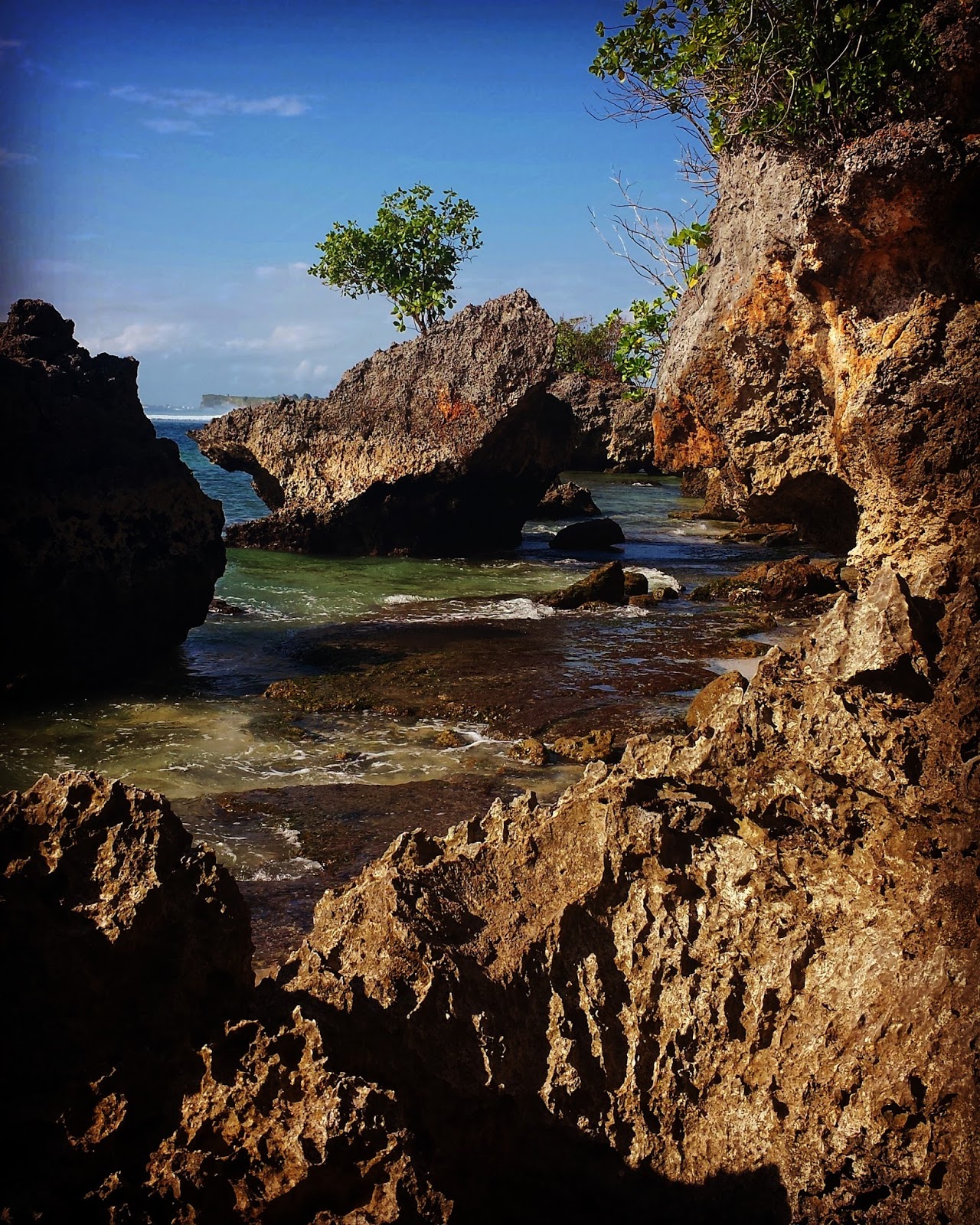
Canggu surfers, Bingin bliss, Padang rocks, Uluwatu sunset--I made my way down the southwest coast lingering just long enough to catch the vibe of each place. I squeezed myself between the narrow crevasse of the cliff and down the steep, winding, stone stairs that led to Padang Padang Beach. I sat in the sand drinking straight from a coconut and eating veggie fried rice from the only little food shack on the beach. This is how I want to remember Bali--fried rice, coconut, beach, sun.


IV.
In between island adventures and searching for the best gado-gado in all of Ubud, I spend my days upside down. I take yoga classes that focus on inversions and hanging from swings. In these upside down moments, I begin to see my life as an incohesive cluster of stories. Pull a memory every 5 years and you'd never know they were from the life of the same person.

I stitch together these memories, these incohesive stories and turn them right side up. My life is not a novel. It's a series of vignettes, a collection of short stories made of memories loosely bound by my natural inclination of curiosity and stubborn refusal to fall into bad habits and unhappy patterns.


Like the busy, relentless streets of Ubud--where you have to follow the narrow, seemingly dead end alleyways and unassuming business entrances to find mysterious never-ending jungle walkways and lush gardens and peaceful, quiet spaces--you need to fall between the words that trigger memories to find that big open space where the stories hide. Or maybe all you need to do is turn upside down and let them fall into place.


Do you see your life as a collection of short stories--a jumbled, patchwork of memories? Or a novel--a cohesive, unfolding story? Do you believe your memories are the sum of your life or do you see the sum of your life in other ways? Tell me about the lenses you see your life through. 

Monday, May 23, 2016

Bending Reality

A friend wrote me recently asking me how I've been able to bend reality to my favor. The comment made me smile because I had been thinking about making this post for awhile. This was my nudge.

I put a lot of focus and effort into getting where I am, but along with that effort, there were forces at work guiding me toward this reality. And along with the obvious efforts of budgeting, saving money, and doing massive amounts of research, there were a few other factors that played into it as well. I watched miracles unfold in my life those last few years in Santa Cruz that streamlined my life into one I only dreamed about years before when I initially set my goal to travel long term. In other words, I bent reality to my favor.


The Law of Attraction

We've all been exposed to the law of attraction in one form or another--from the Secret, to the teachings of Abraham-Hicks, to the Sermon on the Mount. The basic idea is to ask for something, let it go, and you'll receive it. It's the letting go part that tends to trip people up, but it's the most essential step. Once you ask for something, don't dwell on it or worry about it, don't beg for it daily, don't expect immediate results, and most importantly, don't demand a deadline.

Along with asking* you must also make an effort to continue working toward what you want because the secret is in the combined effort of believing that you will receive what you ask for while you work to attain it. Live as though it's already your reality. The moment you begin to sink into negative thought patterns of not having what you want you begin to push it away. As I worked toward reaching my goal, I watched as my path was cleared and obstacles vanished. People and situations and opportunities began to manifest in my life that guided, and in some cases, pushed or pulled me along the way.

This isn't the easiest process or the most comfortable. You might have a lot of inner work to do first. Things might get a whole lot worse before they get better. It might take a long while, it might not. Trust the process, don't resist it.

*pray, create a vision board, write a letter to your future self, make lists, keep a journal, practice visualization exercises


A Course In Miracles

One of those things that manifested on my path via the incredible world of networking and social media was a lady named Gabby Bernstein. She had just written a book called May Cause Miracles which is a condensed, easy to grasp version of A Course In Miracles. The book guides you through 40 days of practices that will change the way you see the world around you. It focuses on turning fear into love, forgiving (not just others, but yourself as well), living in gratitude, and becoming miracle minded. I didn't just do these practices for 40 days--I kept practicing them, and I still do today.


Yoga

I don't recall learning about yoga. It was one of those things (and there are a few) that seemed to stick from lifetimes past--a deep understanding of what exactly it was even as a child--as though the knowledge had always been there. Years later, when I began to read the ancient texts, it didn't feel like I was learning anything new, but it was as though I was unlocking memories. But it wasn't until I stumbled upon a very specific practice of yoga that everything began to shift and change. 

I discovered Kundalini Yoga in a bookshop back in early 2003 when I was living in Montana. I found the book in the store's tiny yoga section. The moment I picked it up I knew I had found my path. I didn't think about it, I didn't question it, I just knew, and I began*.

Kundalini Yoga brings an expanded awareness and consciousness to your world. It clears your energy channels, raises your vibration, creates new neural pathways in your brain, and taps into the latent potential energy stored at the base of your spine. Over time with consistent practice, you'll begin to notice the world no longer has the same control on your mind it once did. Everything you experience is from a completely different perspective--one in which the Universe is conspiring in your favor. You will harness a kind of energy that makes you feel like you're a science fiction character born 500 years too soon. Or maybe even a Jedi.

*Those first few years were all reading and personal practice. It wasn't until early 2007 that I finally found a teacher in Santa Cruz.


Tithing

It works. But, you must do it with ease and without expecting anything in return. Give back to the source which feeds you spiritually--not just any charity, but your church, your yoga studio, a spiritual teacher. If not ten percent, give five or three percent--put it in your monthly budget. Give back with gratitude, let it go, and watch miracles unfold.


Live with Gratitude

Be grateful for everything. Believe that God, the Universe, the Force, (or whatever you'd like to call that of which you are an extension of) is conspiring in your favor always. Even in the most difficult times, find a few things to be grateful for. Sit in silence and think about those things. Write them down or create a happiness jar. If you make this a daily practice, you'll start to notice more and more things you are grateful for until one day you're grateful for everything. And when you get to that place, you'll look around and notice you are living a life that you love.


I wholeheartedly believe in all of these. I also believe in all kinds of magic and fringe that I may explore in later posts. In other words, I believe in a world in which anything and everything is possible.

All of these practices work in equal measure--they complement each other and build off one another, they overlap and bind together. They bring an awareness to our participation in the cosmos--so instead of letting life happen to us, we can help co-create our reality so that it may ultimately bend in our favor.


Have you ever bent reality to your favor? What practices helped you? Or if you are looking to bend reality, experiment with these, incorporate the ones that resonate with you into your life, give it time, and see what happens. Expect miracles.

Saturday, May 14, 2016

Auspicious Signs (or Where the Magic Hides and the Mystery Begins)

When the quirky Balinese medicine man whacked the side of my left arm really hard in the middle of my palm reading, I took it as an auspicious sign. Because this is my life--following these auspicious signs and omens on the coattails of miracles. He was a bit hard to understand and generally tells everyone the same thing anyway, but to be hit? This was for me. This was my omen. This was my firefly.


Nearly 10 years ago, back when I was living in Santa Cruz, I came upon a serial documentary in the library called Ring of Fire about these two brothers back in the early 1970s who took 10 years to explore the Indonesian archipelago and document their discoveries--they hit up all the major islands by boat and let curiosity guide their way. They met a medicine man who could set fire to paper with the energy in his hands, visited villages thriving on creating art, they befriended cannibals, and wandered the jungles searching for nomdic tribes and birds of paradise and komodo dragons. I was mesmerized, and I knew that one day I would go to this magical and mysterious place as well.


My plan for Indonesia round one was to tether myself to Ubud Village on the island of Bali for 6 weeks, explore slowly, and let magic unfold as I had back in India. Inspired by the Ring of Fire brothers, I was going to get swept up in the mystery, I was going to follow magic.


In the past two months since I've left Arambol, I've moved every two weeks, and I've kept busy--not wanting to lose an opportunity to get everything I could out of where I was in two weeks time while still attempting to relax into each environment. That needed to change, but I had inadvertently brought that energy to Bali and I exhausted myself immediately.


Upon arriving in Ubud, sitting in stillness and slowing down did not look promising--there were volcanoes to trek, yoga classes to take, jungles and rice fields to explore, group meetup activities to happen, and let's not forget about the coast and all those beaches! This is Indonesia 2016, not 1972. It has been discovered and developed, and it wants you to know this.


I was not letting stillness and curiosity guide me. I was, as Gurmukh had told us back in Rishikesh, caught in the washing machine. The whack from the medicine man was a reminder of my intention for this year--to move slow and not try to do everything, especially within my first week of arriving somewhere I was going to be living for the next 6 weeks. It was also a reminder of my Rishikesh lesson--to sit in stillness.


It took me a good week or so to slow down and adjust to living in this bustling little tropical jungle town, to find the hidden sleepy streets and desolate rice fields and oasis coves tucked behind the busy surface. Ubud can be a stimulation overload, but if you hone in on the stillness, you'll be led to the right spots at the right times and the entire town shape-shifts to something altogether sublime and unreal. This is where the mystery begins. This is where magic hides.


Do you tend to get caught up in life and forget to slow down and be still? What do you do to bring yourself back to that point of stillness where you can slow down? What happens when you do? What mysteries are unveiled? 

Monday, May 2, 2016

Thriving in Movement

My last week in Nepal and I feel the heaviness of the pre-monsoon heat beginning to weigh on me. The heat and smog trapped in the atmosphere create a haze that hangs over everything. You can't quite see anything clearly through the thickness of it, and it makes a terrible environment for doing anything productive. Landlocked and hazy-headed--no one can thrive in this environment. I think I might have read that in a guide book.


Moving through the world at this slow pace, I've been able to get a better idea of what environments I thrive in best--where I find that perfect equilibrium of productivity and relaxation, where I'm never too restless or bored. In the past 4 months, I have moved across India and Nepal living in six very different towns and situations, and I have found ways to thrive in each of them. I could have lingered in some places to see how long my momentum would last, and in others, I knew it was time to move on. But was it the place that I was thriving in or the movement from place to place?


"The heavier the burden, the closer our lives come to the earth, the more real and truthful they become. Conversely, the absolute absence of burden causes man to be lighter than air, to soar to heights, take leave of the earth and his earthly being, and become only half real, his movements free as they are insignificant. What shall we choose? Weight or lightness?" Milan Kundera, The Unbearable Lightness of Being


It's been ten years since I first read The Unbearable Lightness of Being, and this quote still catches up to me. I took note years ago that the longer I stay in one spot the heavier my life becomes, and over time, I stop thriving. The burden of those things that begin to weigh a person to one place becomes overwhelming, and it can really start to take a toll on the psyche.

Of course, this isn't everyone's reality. Some folks can find their niche and thrive through the heaviness. I have not been able to do this--time and experience have taught me that this way of life is not for me. I need movement to thrive. I can stay for a long while in some places, but ultimately, I will need to move on to continue to grow. I will need to shed the burden and take flight again.


Sometime we don't thrive in the place we were born. Or we move somewhere and thrive for awhile, but once we reach a point, we stop and need to move on. Or we simply stop resonating with a particular place because we've grown and changed. For me, it's perfectly natural to move around in the world, to find those places I resonate with and can thrive in.

What makes you thrive? Does it have to do with place? Have you found your niche where you can thrive long term in one spot or do you need movement?


Signing off from the ancient land of Nepal which, by the way, has the most incredible landscape of any place I've seen in my entire life. Tomorrow night I finally leave for tropical Southeast Asia where I'll spend the rest of the year. First stop: Bali! 

Tuesday, April 26, 2016

The Yin and Yang of Nepal

I meander down the alleyway streets where markets pop out of cement walls of tall crumbling buildings. The smell of spices and dusty roads follow me for hours in every direction--each area of this sprawling city spilling into the next, each teetering on the edge of ancient and modern.


The towering stupas and temples scattered throughout Kathmandu a constant reminder of exactly how old this city is. One young boy rides by on his rickshaw passing another resting against a temple wall, eyes glued to his cell phone.


I follow the guys from Malta and their Sherpa around the city as they prepare for their trek and summit of Lobuche Peak that sits at a humbling 6100 meters (that's over 20,000 feet, by the way). They collect items like heavy coats and ice picks and crampons while temperatures outside the shops push 90 degrees (32 C). There aren't many places in the world this is your reality.


Despite the 24 hour buzz, there is an underlying bliss to Kathmandu--a calming energy that permeates the chaos and noise. I slip into a yoga class or cafe, and the world outside disappears. I sit for hours among the soft conversations and distant honk of the horns, and I forget where I am. And when I step outside, I'm again swept up in the sparkling energy and life that pulses down every street and over every rooftop.


Here in Pokhara, the second largest city in Nepal next to Kathmandu, the whole world is still. I walk from one end of the lakeside to the other and follow the footpath along the lake back home. Canoes and fishermen line the shore, and Nepalese children run along the bank splashing water around the shallow edge.


My new friends and I wake before dawn to watch the sunrise at Sarangkot. Like an apparition, the Annapurna Range materializes in the distance, and it lingers for just a moment before it vanishes into the light of the sun.


We hike back to town--down steep, stone stairs and paths that cut through tiny villages coming to life with morning chores--women tending to the chickens and goats and filling water jugs, children chasing each other from one shack down the road to another.

Can you image growing up here, this being the only life you know, these people being your only lifelong friends and family? Elena asks. We talk about what we must seem like to them--us traipsing through their world carrying next to nothing. They probably wonder: who are these people, where do they come from, and where in the world are they going? An outside foreign energy sweeping through their quiet lives.


Whereas everyone in Kathmandu was preparing for a trek or returning from one in the not so easily accessible Everest Region, here in Pokhara no one seems to be coming or going from anywhere. The Pokhara Valley hugs against the Annapurna Range making it some of the most accessible and well traveled Himalayan trekking territory, yet people linger here--their treks a distant memory or distant plan. Unlike Kathmandu, there is an urgency lacking here. I hear stories of local cults and murders and folks who dose on acid and wander off on a 15 day trek--a dark, invisible undercurrent that pulses through these peaceful streets.


I've come to see these two cities as the yin and yang of Nepal, swirling energies around each other linked by a single stretch of two lane road that winds though the countryside--mountain walls on one side and a steep cliff overlooking a deep river valley on the other. We pass long suspension bridges linking small villages on one side of the river with kilometers of rice fields etched into the hills on the other side. What would it be like to live here in the in-between, to grow up here not knowing any other world?

The bus slows down, and I make eye contact with a young teenage girl and her face lights up and she waves wildly. I turn and strain to see if she's chasing the bus, but I can't see anything except for the shrinking landscape behind me and dust blowing around in our wake.


Can you see the darkness in the most blissful places? Can you see the bliss in the most unpleasant places? Tell me about a place where you penetrated the surface and saw what was underneath. 

Saturday, April 16, 2016

In Search of My Fortune and Glory

I got lost in Patan searching for my fortune and glory.

Let me start over. I got lost in Patan searching for a fictional tavern and a t-shirt I'm pretty sure was never actually sold in Patan, Nepal.


Let me start from the beginning. It all started when another girl from California at my guesthouse asked me what I was doing in Nepal. I told her that I was traveling, living here for the month, writing, and exploring. Oh, just hanging out, that's cool, I suppose, she said.

It wasn't so much what she said, but how she said it that got to me.

Turns out, everyone in Kathmandu has a purpose for being here--everyone is either starting a trek or finishing a trek, never around longer than 3 or 5 days, or they're here for school or a job or a volunteer opportunity. Whereas hanging out in India writing a novel and practicing yoga was a perfectly reasonable explanation for being there, folks here in Nepal seem a bit taken aback, like I've just told them I'm here searching for my fortune and glory, and they just don't know how to respond.


So, I decided to make my stay here one with a purpose. Why not search for my fortune and glory? Indiana Jones meets Murakami style.

I.
Happy New Year 2073! The guy shouted into the microphone at the cafe I found myself in on what appeared to be New Year's Eve. I had seen a couple signs hanging high over the city streets on my way to the cafe, but I had also just finished another Murakami novel so I wasn't too shocked.


The Scottish man sitting across the table from me who had just finished 20 days on the Annapurna Circuit, choked on his beer. "Good God," he managed to say. "How long have I been gone?" He seemed genuinely confused and a bit concerned.

"The Nepalese people live in the future," I told him. "Last month when I was in India, my yoga teacher told our class we were science fiction characters so it seems about right I'm here."

He furrowed his brow and crossed his arms. "What trek did you do?" He asked me.

"I've not done one yet," I said. "But I am thinking of trekking to Patan to look for a fictional tavern."

He sighed and finished the last gulp of his beer. "I'm really tired," he said. "Maybe I should get some sleep."

"That's probably a good idea," I told him. "You have about 58 years to catch up on."

He gave me an odd little laugh and waved goodbye leaving me forever wondering if he thought he was actually gone for 58 years. But then again, how did it get to be New Year's Eve 2073? I hadn't even gotten to the bottom of that mystery yet.


II.
What exactly are the odds of meeting two people from the island Malta (population 400,000) in Kathmandu, Nepal less than 2 months after I read a Murakami novel in which a character named herself Malta (after the island)? And since Nepal seems to be a vortex for all things extreme--extreme mountains, extreme trekkers, extreme earthquakes, extreme activity of every kind, who says it won't be a place of extreme coincidences as well?


The night I met the first guy from Malta we were hanging out on the rooftop of our house when a 4.5 earthquake hit. Everyone stopped talking as the world uncontrollably shook around us and the lights flickered on and off. What are the odds that nearly a year after a series of devastating earthquakes shake this country to the core, another one hits? It lasted about 5 seconds, and when it stopped, we all looked at each other, waiting. Then, as sudden as it happened, we all burst into uncontrollable laughter because, really, what else is there to do?


The next morning I and my new earthquake surviving friends--one of the guys from Malta and a girl from North Carolina--found ourselves on a high overlook in the countryside of Nagarkot watching as the sun rose directly behind Mount Everest. The Himalayan Range in the far distance popped out of the horizon until the sun rose too high and whitewashed them out of sight. The moment was fleeting and magical--a snapshot reminder of my time in India as well as here in Nepal.


Two days later I saw Everest again from the window of a small prop plane on a flyby. Seeing the highest peak in the world twice in one week can leave one feeling a little surreal--like living in the year 2073 and experiencing an earthquake from a rooftop in Kathmandu. Both unlikely, but as real as everything I've experienced so far on this journey.


What are the odds I'll find the Raven Tavern? I asked the guys from Malta later that night. They had no idea what I was talking about. You know, Marion Ravenwood's tavern from Raiders of the Lost Ark, I continued.

It didn't occur to me until that moment that Indiana Jones, whose travels and adventures took him to far flung regions of the world looking for his fortune and glory, is in fact a fictional character who doesn't really exist. A jarring fact for someone like me who lives in self constructed fictional worlds where Indiana Jones really does exist, and it really is possible to be a science fiction character and fall into Murakami wells of weirdness.


And because I am a believer in this world of magic and adventure, I'm going to live in it as much as I can.

III.
When I finally set out on my own adventure into Patan just south of Kathmandu, it was late in the day. The GPS on my phone said it would only take about an hour to walk there so I thought I had plenty of time. Little did I know the convoluted path I was following would take me through the strangest of winding alleyways where I suspect no tourist has ventured by the looks I got.


I did eventually make it to Patan where I found a quaint little brick cafe. I sipped on my coffee and asked the guys working if they knew where I could find the Raven Tavern.

"The Raven Tavern?" One of them asked.

"Yeah," I said with a sigh. "It might not actually exist. As the story goes, it burnt down in 1936 when one too many people were after their fortune and glory. That is, if it existed at all."

The boys looked at me as though I just told them the sun was purple.


By the time I decided to give up on finding the Raven Tavern, the sun was starting to set and my phone had died. I don't know how long it actually took me to get back home, but I had a map and the streets were full of helpful folks (who didn't speak English, but understood map).


I did not find my fortune and glory in Patan, Nepal, but what I did find was that I can navigate in a world where I am lost after dark, where not many folks can speak English, where I am always alone and never alone, where I can blend into any environment, where I am at peace where I am and where I've been and where I'm going as long as I continue to follow my curiosity into this world of magic and wonder.

How do you view yourself in the world--grounded in the reality that is around you or one in which magic is possible and fictional characters are as real as historical ones? And how does it affect your world and how you see it?


By the way, the Nepalese calendar was started in the year 56 BC by an Indian king who may or may not have existed--there doesn't seem to be a consensus on this issue. 

Sunday, April 3, 2016

The Event Horizon Effect

It could have been the lack of oxygen at nearly 9500 ft (2900 m)...or it could have been the meditation I'd been doing every morning since my week training with Gurmukh...or it could have been all the writing and thinking I'd been doing for the past 3 months, but some sort of cumulative explosion happened in my brain when I reached Triund, and the world stood still.


Actually, the world has stood still in each and every moment of my experience in India. It would be easy to say time works differently here, but that's not it at all. Time no longer works in my life the way it once did--I simply experience it differently.

A friend wrote me recently about how these past 3 months have flown by. Well, yes, three months have gone by, but they have been so rich and full they feel like they were hardly moving at all as I was experiencing them. Each day would last a lifetime. Each moment would linger in an everlasting event horizon of sorts.


Whether I was practicing yoga as the sun came up over the backwaters of Kerala or listening to live music on a warm tropical night at a beach side shack in Arambol or white water rafting on the Ganges River in Rishikesh or scrambling up the side of a mountain in Dharamsala, I was fully present for each moment--not once living in the past or the future. And because I was so fully present, each experience never really ended.


After hiking for 5 hours of what felt like never ending vertical rocks to Triund, I found myself on a plateau that not only overlooked every village that makes up Dharamsala on one side, but I could turn around and clearly see snow capped Himalayan peaks right in front of me--so close I could almost touch them. And I do know from my past experience of hiking high elevations on a regular basis back when I lived in Yellowstone National Park that breathing thin, clean air can be one of the most magical and exhilarating experiences.


It was then, catching my breath, that I took note of the event horizon effect--standing on the edge of a precipice, witnessing not only that moment, but all my India moments--forever experiencing them as they move further and further away.


Three months, four different states, four different towns--each so incredibly distinct from each other, each surprising me in radically different ways that I could never have dreamed.

How do you experience time? Do you tend to mostly live in the past and future? Or do you take the time to fully experience the present moment? Experiment with time! How does your awareness of how you live in time change how you experience it? I'm so curious about this! Let me know what happens, what you experience!


From mountain climbing to theoretical physics in a single post...didn't something like this happen several posts back? Perhaps a side effect of what happens when time slows down.

In a few days, I will be not only in a whole new town (and by town, I mean big city!), but an entirely new country!

"Kathmandu, I'll soon be seein' you
And your strange bewinderin' time
Will hold me down"
~ (ahem) Cat Stevens